
How to Learn English Effectively ? The Mastery Guide

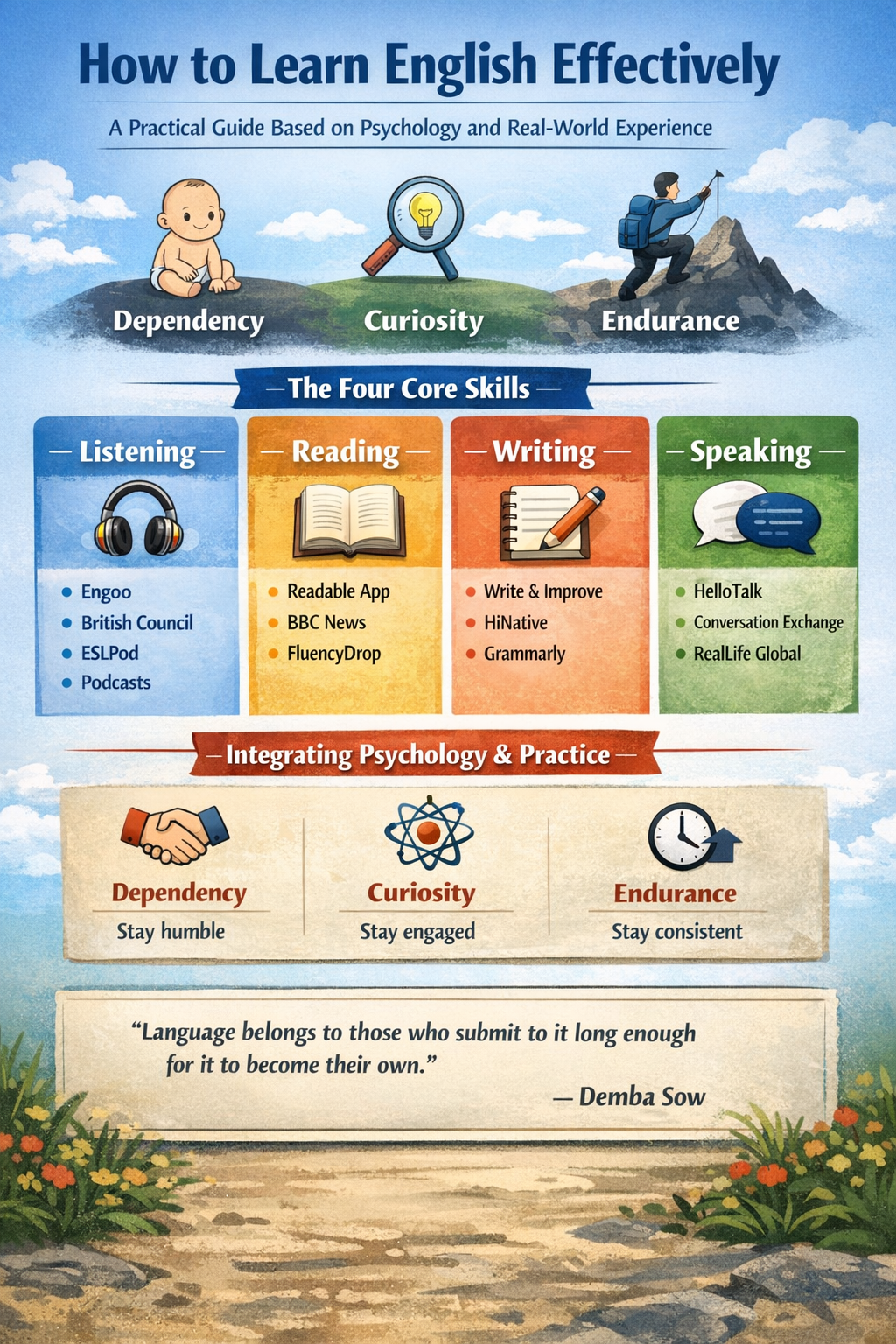
This document presents a structured, psychology-informed approach to learning English. It integrates the four core language skills: Listening, Reading, Writing, and Speaking, with 3 foundational psychological principles (extracted from my upcoming book series: The IELTS Mastery) that will determine your long-term success in your language acquisition. The 3 main principles can be applied to any kind of learning, however here we attempt to tailor them specifically to English Learning.
I. The Psychology of Learning a Language
Before focusing on techniques and materials, it is essential to understand the mental framework required to learn a language effectively. Language learning is not only a cognitive process; it is deeply psychological.
1. Dependency: Adopting the Right Power Dynamic
To truly acquire a language, the learner must abandon feelings of superiority toward the people who speak it natively. Language is not mastered from a position of dominance; it is absorbed from a position of dependency.
Think of how a baby learns a language. The baby depends entirely on its caregivers for survival, food, safety, and emotional connection. Because of this dependency, the baby listens attentively, imitates without shame, and accepts correction naturally.
For an adult learner, this means:
- Accepting that native speakers know more than you
- Allowing yourself to sound imperfect or childish
- Letting the language shape you, rather than trying to control it
When you mentally place yourself in a position where understanding English feels necessary; socially, professionally, or intellectually, you accelerate learning dramatically.
2. Curiosity: Reverting to a Childlike Mindset
Children learn languages quickly because they are endlessly curious. They ask questions, notice patterns, and explore sounds without fear of mistakes.
As an adult learner, you must deliberately reactivate this curiosity:
- Why is this phrase used instead of another?
- Why does this sentence sound natural while another does not?
- How does tone change meaning?
And the list goes on.
When you revert to a child-like mind, your brain asks all sorts of questions that will ignite your curiosity and accelerate your learning capacity to Curiosity transforms learning from obligation into exploration. Instead of memorizing rules, you begin discovering how the language works.
3. Endurance: Tolerating Boredom and Frustration
Language learning inevitably includes periods of stagnation, confusion, and boredom. Progress is not linear. You might forget the vocabulary you learnt. In fact, you will definitely forget most of it and that’s completely fine.
Grammar will feel daunting and repetitive. Listening may feel difficult and overwhelming. That’s all completely fine.
Endurance is the ability to continue despite these obstacles. Successful learners understand that:
- Tedium is not something permanent, it’s temporary.
- Confusion often precedes breakthroughs: when confused, you might take a small break and later come back. Never let it push you to give up.
- Consistency matters more than motivation.
Endurance turns short-term effort into long-term competence.
II. The Four Core Components of Learning English
An effective learning system must train all four language skills simultaneously. Neglecting one weakens the others.
1. Listening: Building the Foundation
Listening is the primary gateway to language acquisition. Before you can speak well, you must hear well.
How to Practice Listening Effectively
- Listen daily, even passively
- Focus on natural speech, not only educational recordings
- Re-listen to the same material multiple times
Resources
You can find listening resources all over the internet for free.
- Use (https://engoo.com) Engoo.com, a platform that provides high-quality reading and listening resources for English learners. One of Engoo’s key strengths is its flexibility: learners can filter content by level, topic, and difficulty. This makes it easy to find appropriate listening materials regardless of your current proficiency, ensuring consistent and effective practice at every stage of learning. Go ahead, open an account in (https://engoo.com) Engoo.com and start your listening journey.
- Podcasts for learners and native speakers. Use websites like (https://learnenglish.britishcouncil.org) learnenglish.britishcouncil.org, (https://tv.eslpod.com) tv.eslpod.com, (https://podcasts.apple.com) podcasts.apple.com or (https://www.podcastsinenglish.com) www.podcastsinenglish.com
- TV series or films with English subtitles.
For children: Peppa Pig, Dora the Explorer.
For adults: Friends, The Office (US/UK), Brooklyn Nine-Nine, Modern Family.
For advanced learners: Stranger Things, The Crown or Downton Abbey.
Documentaries and films also work fine. - Audiobooks while following the text. You can use (https://www.digitalbook.io) Digitalbook.io, (https://www.esl-bits.eu) esl-bits.eu or choose audio books of the books you had already read. Listen to (https://www.youtube.com) youtube or (https://www.spotify.com) Spotify to listen to any kind of English content.
Here what matters the most is your constant exposure to the language. Listening English constantly and daily will train your brain to recognize sounds, rhythm, intonation, and common sentence structures automatically.
2. Reading: Expanding Vocabulary and Structure
Reading strengthens vocabulary, grammar intuition, and comprehension speed.
How to Practice Reading Effectively
- Choose texts slightly above your current level
- Do not translate every word; focus on meaning
- Re-read texts to reinforce patterns
Resources
- Use (https://engoo.com) Engoo.com again for reading.
- You can also use graded readers a good free app is (https://readable.app) readable.app application or (https://erfoundation.org) erfoundation.org website
- News articles such as (https://www.bbc.com/news) BBC news.
- Short stories and novels use apps like (https://fluencydrop.com) fluencydrop.com, (https://readable.app) readable.app, or websites like (https://www.linguapress.com) linguapress.com or (https://www.wooenglish.com) wooenglish.com
- Professional texts related to your field (Your work or department). You can read anything in English related to your field and the level does not matter.
The main goal here is to internalize how English sentences are formed and how ideas are logically connected.
3. Writing: Clarifying Thought Through Language
Writing forces precision. It reveals gaps in vocabulary and grammar that passive skills may hide.
How to Practice Writing Effectively
- Write regularly, even short texts
- Focus on clarity, not perfection
- Review and rewrite your texts
Resources
- Daily journals. You use journaling platforms or if you are an iPhone user, the phone comes with a very sophisticated journaling app. You can search journaling examples online for inspiration.
- Short essays or summaries. Use the write & improve method: You will write short essays and texts, the web app will show you feedback and suggestions. Head to Cambridge website (https://writeandimprove.com) writeandimprove.com open an account and start writing. You can also use the app (https://hinative.com) hinative.com/lang-8 where you can write short posts and receive corrections from native speakers.
- Emails or professional messages. Use mail mentor (https://mailmeteor.com) mailmeteor.com or (https://www.grammarly.com) Grammarly www.grammarly.com or even AI chatbots: such as (https://chatgpt.com) ChatGPT, (https://gemini.google.com) Gemini, (https://www.deepseek.com) DeepSeek to receive feedback and suggestions for your email.
- Rewriting texts you have read or listened to. Simply rewrite the things you have heard of or write things that simply interest you and use AI tools to get feedback and suggestions.
The main objective is to transform passive knowledge into active, usable language.
4. Speaking: Activating the Language
Speaking is the most psychologically challenging skill because it exposes mistakes publicly. However, it is essential for fluency.
Many learners fall into a common trap when they attempt to speak, a phenomenon I describe in my upcoming book “Silence Knowledge”. It refers to learners who can understand almost everything they read or hear yet freeze when they are required to speak. Despite having sufficient knowledge, they struggle to produce language in real time.
This blockage is often rooted in past negative experiences and a fear of embarrassment, typically caused by the anticipation of being judged by others.
To overcome the Silence Knowledge phenomenon, you must apply the three principles outlined above. In addition, you must consciously adopt the same mindset a child has when learning to speak or walk: a complete indifference to being laughed at.
Children progress quickly because they are not constrained by fear, self-judgment, or social comparison. As adults, we lose this freedom not because our ability disappears, but because society imposes rules, expectations, and evaluations that shape our behavior. Over time, we internalize these judgments and begin to censor ourselves.
If you observe the fastest language learners or learners of any skill in general, you will notice a common trait: they are neither shy nor embarrassed by mistakes. They speak despite imperfection. They ask questions of all sorts. Ironically, this boldness often earns admiration rather than ridicule. Eventually, such learners become models for others, not because they are flawless, but because they are fearless.
How to Practice Speaking Effectively
- Speak early and often
- Accept mistakes as part of the process
- Prioritize communication over accuracy
Resources
- Conversations with native or fluent speakers. You can use apps such as (https://www.hellotalk.com) www.hellotalk.com, (https://www.conversationexchange.com) ConversationExchange.com, (https://www.lrngo.com) LRNGO or (https://www.englishspeakingclub.com) English.Speaking.Club. At the same time, you can utilize AI(Artificial Intelligence) Chat Applications like: (https://chatgpt.com) ChatGPT, (https://gemini.google.com) Gemini, (https://www.deepseek.com) DeepSeek or any other AI application
- Speaking aloud to yourself. Use your phone’s voice recorder. Shadowing with free audio sources. Shadowing refers to repeating someone else’s speech in the exact same tone. You can also use the website (https://reallifeglobal.com) reallifeglobal.com to practice with other English learners.
- Shadowing (repeating after audio or video speech): As mentioned above, you can use shadowing techniques to improve both your speaking fluency and your accent.
These are just a few of the methods you can use. More speaking techniques are covered in my upcoming book series, The IELTS Mastery. The key objective here is to develop confidence, fluency, and automatic language production.
III. Integrating Psychology and Practice
True progress occurs when psychological readiness and practical training work together:
- Dependency keeps you humble and receptive
- Curiosity keeps you engaged
- Endurance keeps you consistent
Combined with balanced practice across listening, reading, writing, and speaking, these principles form a complete system for learning English.
To just some up, remember that, just like any other skill, learning English might not be that of a quick task, but it is a deeply rewarding as it opens doors for you. Those who succeed in learning English are not necessarily the most intelligent or talented, but they just adopted the correct mindset, remained curious, and endured the inevitable difficulties.
“Language belongs to those who submit to it long enough for it to become their own.”


