
How to Self-Assess Your IELTS Writing - Like a Real Examiner

One of the biggest mistakes IELTS candidates make is writing many essays without properly evaluating them.
- They write.
- They check the sample answer.
- Then they move on.
But that is not how improvement works.
IELTS Writing improvement happens when you analyze your writing the same way IELTS examiners do.
This section will teach you exactly how to do that using the self-assessment test provided in “All About Writing” Book.
By the end of this guide, you will know how to:
- Simulate the real IELTS writing test
- Evaluate Task 1 and Task 2 separately
- Score your writing using official IELTS criteria
- Identify your weaknesses and your candidate profile.
- Create clear improvement targets
Step 1. Simulate the Real IELTS Writing Test
Before assessing your writing, you must recreate the real test conditions.
IELTS Writing is not only about language ability.
It also tests discipline, organization, and time management.
Official Time Limits
| Task | Time | Word Requirement |
| Task 1 | 20 minutes | Minimum 150 words |
| Task 2 | 40 minutes | Minimum 250 words |
Total test time: 60 minutes
Simulation Rules
When completing the self-assessment test in this book:
- Set a 60-minute timer
- Write Task 1 first
- Do not use dictionaries or online tools
- Do not rewrite your essay after time ends
- Stop immediately when time finishes
This ensures your result reflects your true IELTS level.
Step 2. Understand How IELTS Examiners Score Writing
Both tasks are evaluated using four criteria.
Each criterion represents 25% of the final score.
| IELTS Criterion | What It Means |
| Task Achievement / Task Response | Did you answer the question fully? |
| Coherence and Cohesion | Is the essay logically organized? |
| Lexical Resource | Is the vocabulary varied and accurate? |
| Grammatical Range and Accuracy | Are sentence structures correct and varied? |
Note. Task 2 is worth twice as much as Task 1 in the final writing score. Example.
This means Task 2 has greater influence on your final band score. |
Step 3. Self-Assess Task 1
Task 1 differs depending on the IELTS version. Apply the same instructions for each of task 1 writing in the self-assessment test.
Academic
Describe visual data (graphs, charts, diagrams, maps).
General Training
Write a letter responding to a situation.
| Skill Area | Self-Assessment Questions / Checklist |
| Task Achievement | Did you: • Write at least 150 words • Provide an overview of key information • Include important data or trends • Avoid irrelevant information |
| Coherence and Cohesion | Check if your writing includes: • Clear paragraph structure • Logical information order • Linking words (however, meanwhile, overall, therefore) |
| Lexical Resource | Ask yourself: • Did I avoid repeating the same words? • Did I use accurate vocabulary for describing trends? Examples: increase, rise, climb, grow, surge |
| Grammar | Check for: • Sentence variety • Correct verb tenses • Articles (a, an, the) • Subject-verb agreement |
Examples.
Example Task 1 Question (Academic)
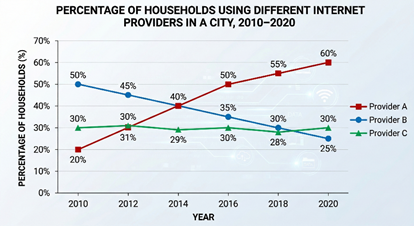
WRITING TASK 1 The chart below shows the percentage of households using three different internet providers in a city between 2010 and 2020.
Write at least 150 words.
|
Student Example. Band 5 Response
The chart shows the use of internet companies between 2010 and 2020. Provider A increased a lot while Provider B decreased. Provider C stayed almost the same. In 2010 provider A had around 20 percent users and then it went up to about 60 percent in 2020. Provider B started with 50 percent but then it dropped slowly. Provider C was about 30 percent and it stayed similar. Overall provider A became more popular. |
Examiner-Style Assessment
| Criterion | Band | Reason |
| Task Achievement | 5 | Overview is very basic and data support is limited |
| Coherence | 5 | Paragraphing exists but ideas are simple |
| Vocabulary | 5 | Limited range of vocabulary |
| Grammar | 5 | Simple structures with noticeable errors |
Estimated Band: 5.0
Student Example. Band 7 Response
The chart illustrates the proportion of households using three internet providers in a city between 2010 and 2020. Overall, Provider A experienced significant growth and became the dominant service by 2020, whereas Provider B steadily declined. Provider C remained relatively stable throughout the period. In 2010, Provider B accounted for the largest share at approximately 50%, followed by Provider C at around 30%. In contrast, only about 20% of households used Provider A. However, over the following decade, Provider A grew rapidly and reached nearly 60% by 2020. Meanwhile, Provider B fell gradually to roughly 25%. Provider C fluctuated slightly but remained close to 30%. |
Examiner-Style Assessment
| Criterion | Band | Reason |
| Task Achievement | 7 | Clear overview and relevant comparisons |
| Coherence | 7 | Logical structure with effective linking |
| Vocabulary | 7 | Good range of descriptive vocabulary |
| Grammar | 7 | Variety of structures with minor errors |
Estimated Band: 7.0
Step 4. Self-Assess Task 2 (Essay)
Task 2 requires you to present and develop an argument.
Minimum word count: 250 words
| Section | Content |
| Task Response | Ask yourself: • Did I answer every part of the question? • Did I clearly state my position or opinion? • Did I support my ideas with examples or explanations? |
| Coherence and Cohesion | Check your structure: Introduction: Introduce topic and thesis |
| Vocabulary | Strong essays include vocabulary such as: Significant, consequently, moreover, therefore, nevertheless etc. Avoid repeating words like: people, things, good, bad etc. |
| Grammar | Look for: • Complex sentences • Correct punctuation • Accurate verb forms Example of variety: Simple sentence: People work remotely. Complex sentence: Many employees prefer remote work because it improves work-life balance. |
Example Task 2 Question
WRITING TASK 2 Some people believe that working from home improves productivity, while others think it reduces efficiency. Discuss both views and give your opinion. Write at least 250 words. |
Student Example. Band 5 Essay (Excerpt)
Some people think working from home is good but others think it is not good. In my opinion it can be good sometimes. First, working from home saves time because people do not travel to work. This can help workers relax more. However some workers become lazy when they work from home. They watch TV or do other things. |
Examiner-Style Assessment
| Criterion | Band | Reason |
| Task Response | 5 | Ideas are underdeveloped |
| Coherence | 5 | Structure exists but weak linking |
| Vocabulary | 5 | Limited word variety |
| Grammar | 5 | Mostly simple sentences |
Estimated Band: 5.0
Student Example. Band 7 Essay (Excerpt)
In recent years, remote work has become increasingly common. While some argue that it enhances productivity, others believe it reduces efficiency. This essay will examine both perspectives before presenting my own view. On the one hand, working from home can significantly increase productivity. Employees often save time previously spent commuting, allowing them to focus more on their tasks. Furthermore, a comfortable home environment may reduce stress and improve concentration. On the other hand, remote work may lead to distractions. Without supervision, some employees struggle to maintain discipline. Additionally, communication between colleagues can become less effective when interactions occur primarily online. In my opinion, remote work can improve productivity if workers maintain strong self-discipline and clear communication. |
Estimated Band: 7.0
How to Calculate Your Final Writing Band
Example scoring:
| Criterion | Task 1 | Task 2 |
| Task Achievement | 6 | 7 |
| Coherence | 6 | 7 |
| Vocabulary | 6 | 6 |
| Grammar | 5 | 6 |
Average Task 1 = 5.75 → Band 6
Average Task 2 = 6.5 → Band 6.5
Because Task 2 is weighted more heavily, final writing score ≈ 6.5
5 Golden Rules for Self-Assessment Success
- Be Ruthlessly Honest. The goal isn’t to impress anyone; it’s to understand your real level. Don't overestimate your performance.
- Compare with Band Descriptors. Read official IELTS band descriptors carefully. Mark yourself based on evidence, not feelings.
- Assess Both Tasks Independently. Task 1 and Task 2 require different skills. A high score in one doesn't mean the same for the other.
- Track Consistency. One high-scoring essay doesn’t define your level. Look for patterns across 3–5 essays.
- Reflect Before You Improve. After assessing, always ask:
Why did I lose points? How can I avoid this next time?


